Analog Synth Editor
The Analog Synth Editor provides comprehensive control over the JD-Xi’s analog synthesis engine, offering classic analog synthesis with modern control capabilities. This powerful editor transforms your JD-Xi’s analog synthesis into a professional-grade sound design workstation.
Built with advanced Qt6 technology and featuring real-time parameter control, the Analog Synth Editor serves as your primary workspace for creating, editing, and managing warm, organic analog sounds with the precision and control of modern software synthesizers.
What is the Analog Synth Editor?
The Analog Synth Editor is a specialized interface that provides deep, granular control over the JD-Xi’s analog synthesis engine. Unlike the limited hardware interface, this editor offers expansive, visual control over every parameter with real-time feedback, advanced organization tools, and professional-grade editing capabilities.
The editor represents a dedicated workspace optimized for analog sound design, from basic oscillator control to complex analog synthesis. The editor automatically synchronizes with your JD-Xi hardware, ensuring that every change is instantly reflected in your synthesizer’s sound.
Core Architecture & Design
- ** Traditional Analog Synthesis**
The Analog Synth Editor features a classic analog synthesis architecture: - Classic Oscillator Control: Traditional analog oscillator parameters and waveforms - Warm, Organic Sound: Dedicated analog modeling with vintage character - Performance Controls: Real-time parameter manipulation for live performance - Timbral Shaping: Advanced control over harmonic content and character
- ** Advanced Parameter Management**
Comprehensive Parameter Mapping: Every analog synth parameter is accessible through intuitive controls
Real-time Updates: Instant parameter changes with immediate hardware response
Visual Feedback: Live parameter displays, value indicators, and status monitoring
Preset Integration: Seamless loading, saving, and management of your custom sounds
- ** Professional Workflow Tools**
Live Performance Mode: Optimized interface for real-time performance
Advanced Organization: Categorize, search, and manage your sound library
Project Integration: Export and import settings for use in your DAW
Performance Optimization: Low-latency response for live performance and recording
Analog Synth Editor Features
- Oscillator Control
Classic analog oscillator parameters and waveforms:
- Waveform Selection
Sawtooth Wave: Classic analog sawtooth waveform
Square Wave: Traditional square wave with pulse width control
Triangle Wave: Smooth triangle waveform
Sine Wave: Pure sine wave for fundamental tones
- Oscillator Parameters
Pitch Control: Precise pitch adjustment and tuning
Detune Control: Fine-tuning for detuned effects
Pulse Width: Square wave pulse width modulation
Waveform Mixing: Blend between different waveforms
- Filter Control
Sophisticated analog-style filtering with resonance and modulation:
- Filter Types
Low-Pass Filter: Traditional analog low-pass filtering
High-Pass Filter: High-frequency emphasis
Band-Pass Filter: Frequency band isolation
Multi-Mode Filter: Switchable filter types
- Filter Parameters
Cutoff Frequency: Real-time cutoff control
Resonance: Filter emphasis and character
Envelope Modulation: ADSR control of filter parameters
LFO Modulation: Low-frequency oscillator modulation
- Envelope Shaping
Complete ADSR control with additional envelope stages:
- ADSR Controls
Attack: Initial sound onset control
Decay: Initial decay after attack
Sustain: Sustained level control
Release: Final decay control
- Additional Envelope Stages
Hold: Sustain level holding
Delay: Pre-attack delay
Additional Decay: Multi-stage decay
Envelope Scaling: Time and level scaling
- Effects Integration
Built-in effects processing optimized for analog synthesis:
- Effect Types
Distortion: Harmonic enhancement and saturation
Chorus: Stereo width and movement
Delay: Time-based effects and echoes
Reverb: Spatial effects and ambience
- Effect Parameters
Real-time Control: Live parameter manipulation
Effect Routing: Flexible effect chain routing
Preset Management: Save and recall effect settings
Performance Integration: Optimized for live performance
Analog Synthesis Characteristics
- Warm, Organic Sound
Dedicated analog modeling with vintage character:
- Analog Modeling
Vintage Character: Classic analog synthesizer sound
Warmth: Rich harmonic content and saturation
Organic Feel: Natural, musical sound characteristics
Vintage Accuracy: Faithful reproduction of classic analog sounds
- Harmonic Content
Rich Harmonics: Complex harmonic structures
Natural Saturation: Analog-style harmonic distortion
Warmth Control: Adjustable warmth and character
Vintage Accuracy: Faithful reproduction of classic analog sounds
- Performance Controls
Real-time parameter manipulation for live performance:
- Live Performance
Real-time Updates: Immediate parameter changes
Smooth Transitions: Gradual parameter changes
MIDI Control: External controller integration
Automation: Parameter automation support
- Performance Modes
Live Mode: Optimized for real-time performance
Edit Mode: Detailed parameter editing
Preset Mode: Quick preset switching
Learn Mode: MIDI controller learning
- Timbral Shaping
Advanced control over harmonic content and character:
- Harmonic Control
Oscillator Mixing: Blend between different waveforms
Filter Emphasis: Control harmonic emphasis
Saturation Control: Adjust harmonic distortion
Character Shaping: Fine-tune overall sound character
- Modulation
LFO Modulation: Low-frequency oscillator modulation
Envelope Modulation: Envelope follower modulation
External Modulation: MIDI controller modulation
Internal Modulation: Self-modulation capabilities
Advanced Features
- Real-time Visualization
Live display of waveforms, envelopes, and parameter relationships:
- Waveform Display
Live Waveforms: Real-time waveform visualization
Spectrum Analysis: Frequency domain display
Waveform Comparison: Compare different waveforms
Custom Waveforms: Display user-defined waveforms
- Envelope Visualization
ADSR Display: Visual representation of envelope stages
Envelope Editing: Graphical envelope editing
Envelope Comparison: Compare different envelopes
Envelope Automation: Visual automation display
- Preset Management
Advanced organization and recall of your custom sounds:
- Preset Organization
Categories: Organize presets by type or style
Tags: Add custom tags for easy searching
Favorites: Mark frequently used presets
Recent: Quick access to recently used presets
- Preset Operations
Save: Save current settings as preset
Load: Load existing presets
Copy: Duplicate existing presets
Delete: Remove unwanted presets
- MIDI Integration
Full support for external MIDI controllers and keyboards:
- Controller Support
MIDI Learn: Assign any parameter to any controller
Controller Mapping: Save and recall controller mappings
Multiple Controllers: Support for multiple MIDI controllers
Controller Profiles: Different profiles for different setups
- Keyboard Integration
Note Input: Play notes using MIDI keyboard
Velocity Sensitivity: Respond to playing dynamics
Aftertouch: Support for pressure sensitivity
Pitch Bend: Pitch bend wheel support
Performance Features
- Live Performance Mode
Optimized interface for real-time performance:
- Performance Controls
Large Controls: Easy-to-use controls for live performance
Visual Feedback: Clear indication of current settings
Quick Access: Fast access to frequently used parameters
Preset Switching: Quick preset changes during performance
- Real-time Updates
Instant Response: Immediate parameter changes
Smooth Transitions: Gradual parameter changes
MIDI Control: External controller integration
Automation: Parameter automation support
- Parameter Automation
Advanced parameter automation capabilities:
- Automation Types
LFO Automation: Low-frequency oscillator automation
Envelope Automation: Envelope follower automation
External Automation: MIDI controller automation
Internal Automation: Self-automation capabilities
- Automation Control
Automation Recording: Record parameter changes
Automation Playback: Play back recorded automation
Automation Editing: Edit recorded automation
Automation Management: Organize and manage automation
Getting Started with Analog Synth Editor
- Initial Setup
Launch Analog Synth Editor: Open the Analog Synth Editor from the main interface
Load a Preset: Start with a factory preset to understand the interface
Explore Controls: Familiarize yourself with the available parameters and controls
Test Your Changes: Play notes using the virtual keyboard or MIDI controller
- Basic Workflow
Choose a Waveform: Select the basic waveform for your sound
Adjust Filter: Set the filter cutoff and resonance
Shape Envelope: Adjust the ADSR envelope settings
Add Effects: Apply effects to enhance your sound
Save Your Work: Use the preset management system to save your creations
- Advanced Techniques
Waveform Mixing: Blend different waveforms for complex sounds
Filter Modulation: Use LFO and envelope to modulate the filter
Envelope Shaping: Create complex envelope shapes for unique sounds
Performance Integration: Optimize the interface for live performance
- Tips for Effective Analog Sound Design
Start Simple: Begin with basic waveforms and simple envelopes
Use Filter Modulation: Experiment with filter modulation for movement
Layer Sounds: Combine multiple analog sounds for richness
Save Frequently: Save your work regularly to avoid losing changes
The Analog Synth Editor transforms your Roland JD-Xi’s analog synthesis capabilities into a professional-grade sound design workstation, providing the tools and interface you need to create, edit, and manage warm, organic analog sounds with the precision and control of modern software synthesizers.
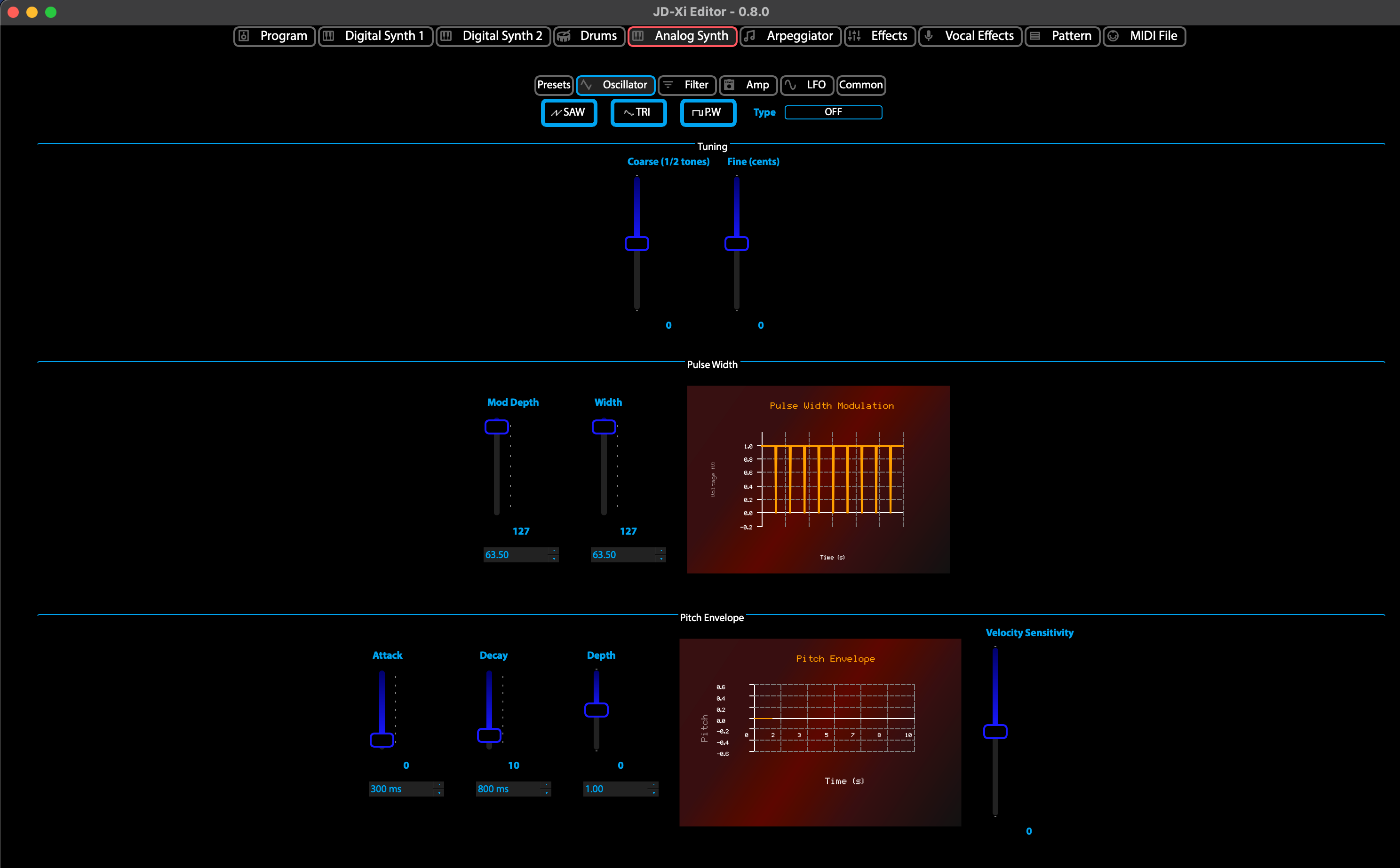
Analog Synth Editor - Classic Synthesis